
CAD/CAM.
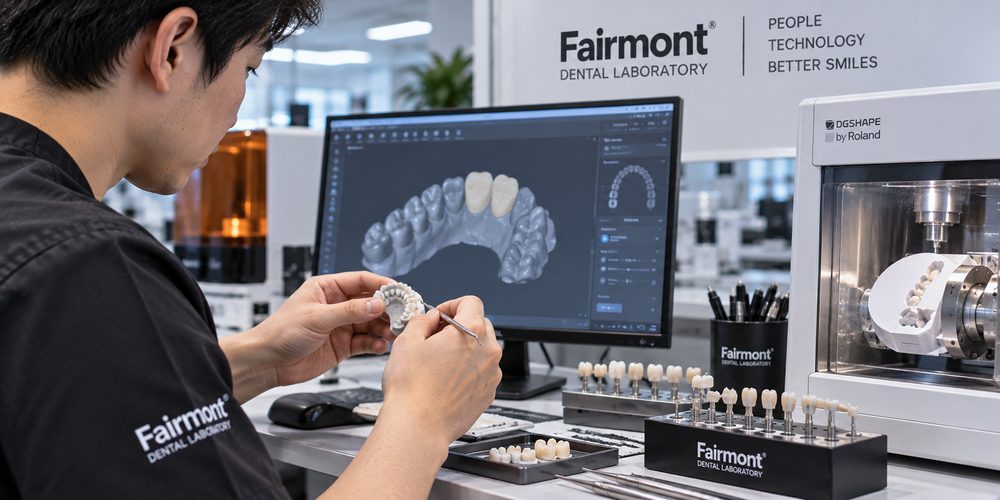
Design software resolves geometry; the technician resolves how a restoration reads and functions in a mouth. Both are necessary, and confusing one for the other is where automated design goes wrong.
What CAD genuinely improves
Consistency, principally. A margin traced digitally and milled reproduces more reliably than one waxed and cast, and internal fit is more predictable across a run of cases.
It also removes a chain of physical error — investment expansion, casting shrinkage, distortion during finishing — that had to be compensated for empirically in a conventional workflow.
And it makes verification practical. A design can be checked against the opposing arch, the insertion axis and the material's minimum thickness before anything is produced.
Where judgement still sits
Software proposes margins, anatomy and occlusal surfaces, and the proposals are increasingly good. What they cannot do is know what was not in the data.
Where the margin was ambiguous in the scan, the software will propose a smooth, confident and possibly wrong one. Where the prescription did not say the patient bruxes, the proposal will not account for it. Where the antagonist is intact natural enamel, nothing in the geometry says so.
A technician reviews and modifies every proposal, which is the difference between automated design and unreviewed design.
Milling and its limits
Subtractive milling produces excellent internal fit and consistent results, and it is constrained by tool geometry — the smallest bur determines the sharpest internal detail achievable.
That is one practical reason preparations should have rounded internal line angles. A sharp internal angle cannot be milled faithfully, so the restoration is relieved there, which costs internal fit at exactly that point.
It is also why margin design matters: a knife-edge margin under ceramic produces a milled edge too thin to survive handling.
Materials that suit the process
Zirconia, lithium disilicate and the indirect composites all mill predictably. Metal frameworks can be milled or cast, and milling gives more consistent internal fit while casting remains appropriate for certain designs and alloys.
Multilayered blanks with graded shade and translucency add a design consideration: the restoration has to be nested correctly within the blank for the gradient to land where it should.
Verification before production
One genuine advantage of designing digitally is that a restoration can be checked before it exists. Minimum material thickness against the opposing arch, connector cross-section on a bridge, insertion axis against the preparation, and contact position against the adjacent teeth are all measurable at the design stage.
That means a clearance problem is identified while the case can still come back to you for a decision, rather than after a restoration has been produced to a compromised thickness.
It is also why a case sent with clearance that was accepted deliberately should say so. Otherwise the check produces a query on something you had already decided.
Design data and reproducibility
A completed design can be stored alongside the scan, which means a fractured restoration can frequently be reproduced exactly rather than redesigned.
For a patient who has had a restoration remade once already, that consistency is worth something — the replacement matches what was accepted rather than being a fresh interpretation.
It applies only while the preparation is unchanged. Any re-preparation makes the stored design a starting point rather than a copy.
What the practice can do to help
Give the software something unambiguous to work from. A clear, continuous finish line, rounded internal angles, verified clearance, and an accurate bite record are worth more to a CAD workflow than to a conventional one, because the software will confidently interpolate over anything missing.
And say what the case needs. Material, antagonist, parafunction, contact form and tightness are all design inputs that geometry does not contain.
More in Digital Dentistry
Send a case
Digital scans and conventional impressions are both accepted. Cases move by UPS and Purolator, and Fairmont works with practices throughout British Columbia and across Canada.