
Orthodontic laboratory.
Appliances are made to the same records standard as restorative work. An appliance built from a distorted impression will not seat comfortably, and one that is uncomfortable will not be worn.
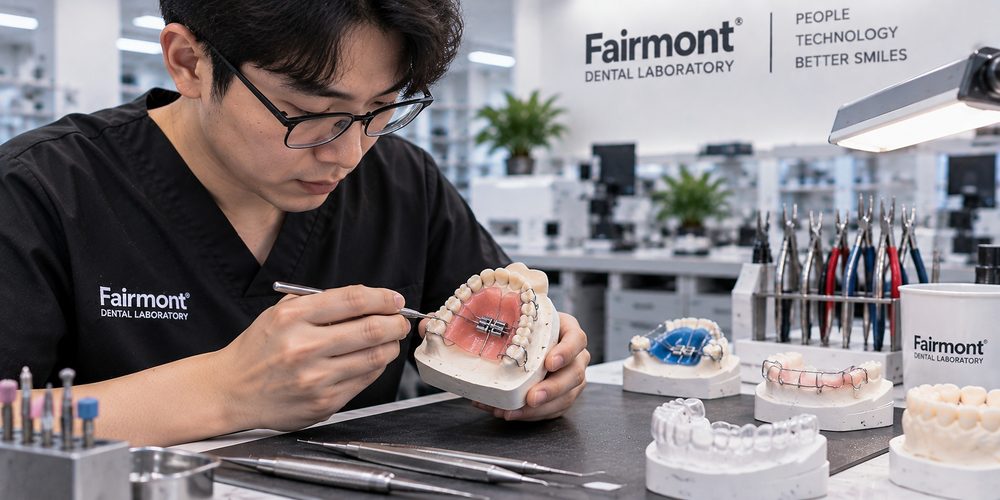
Fit determines compliance
An orthodontic appliance only works if the patient wears it, and whether they wear it depends almost entirely on whether it fits and feels tolerable.
That makes accuracy a clinical priority rather than a laboratory nicety. The impression or scan needs to capture full clinical crowns and the undercuts that provide retention — a record that stops short of the gingival margin produces an appliance that does not hold.
It also makes finish matter. Rough acrylic against tissue is uncomfortable and accumulates plaque, and both reduce the chance the appliance is worn as prescribed.
Tell us what the appliance is for
The same appliance can be designed differently depending on its purpose. A retainer holding a rotation corrected with difficulty is built differently from one maintaining a stable result. A guard for a patient in fixed appliances is designed differently from one for an unrestricted dentition.
Describe the clinical objective alongside the appliance type. It is the information that most often changes the design and it is the most frequently omitted.
Also say when it is needed and whether the patient is mid-treatment, because an appliance made for a dentition that is still moving has a shorter useful life.
Working alongside orthodontic practices
Retention records, appliance repairs and guards for patients in treatment all arrive on tighter timelines than restorative work, because the patient is frequently mid-course and the appliance is holding something.
Say when a case is time-critical and why. A retention record taken at debond is a different situation from a replacement retainer for a patient who lost theirs six months ago, and the sequencing differs.
Where a practice sends orthodontic work regularly, agreeing a standard specification once — clasp design, trim line, material thickness — removes a recurring set of decisions from every case.
Records
Accurate impressions or scans of the arch and, where the appliance engages occlusion, the opposing arch and a bite record.
For thermoformed appliances the model has to be accurate at the gingival margins, because that is where retention comes from. For wire appliances the occlusal and lingual surfaces matter, because that is where components sit.
Cases move by UPS and Purolator, and Fairmont works with dental offices throughout British Columbia and across Canada.
From a practice we work with

Appliances only work if patients actually wear them, and comfort is most of that. Fairmont's retainers and guards seat cleanly, which matters enormously with younger patients who will not tolerate anything that rubs. Their team is easy to reach when a case needs discussing.