
The people behind the work.
A restoration is rarely the work of one person. Understanding how a laboratory is organized explains a good deal about why consistency is achievable at all.
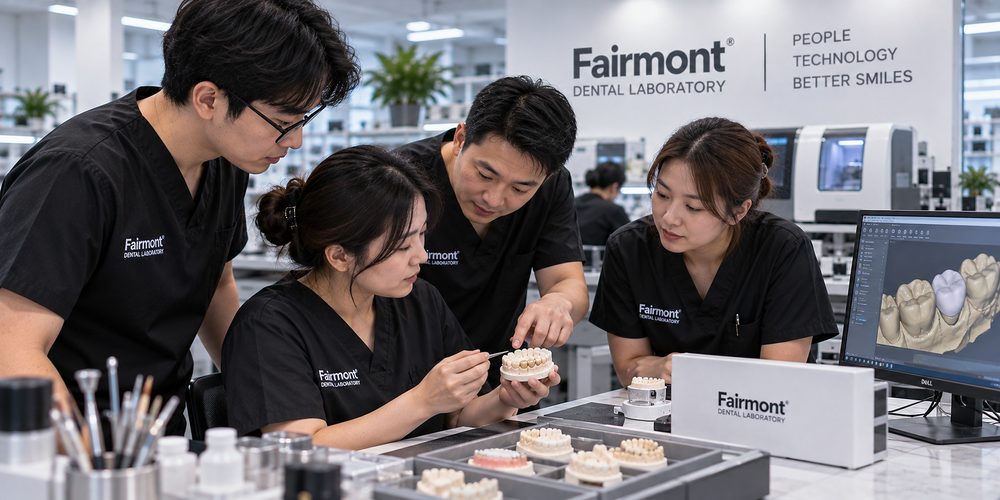
Specialization is what makes results repeatable
Model work, design, substructure production, ceramic application and finishing are handled by technicians who specialize in each area rather than each doing everything.
A ceramist building porcelain every day produces more consistent work than one who does it occasionally between other tasks. That is the whole argument for how a laboratory is structured, and it is why the value of a laboratory shows in the tenth case rather than the first.
It also means a case passes through several hands internally, and each of those transfers relies on what was recorded rather than remembered — which is why a note on the prescription reaches everyone who needs it while something mentioned on the phone may not.
Regulation in British Columbia
Dental technicians in British Columbia are regulated. We are happy to answer questions about who holds registration and what supervision arrangements apply, directly and without fuss.
It is a fair question for a practice to ask any laboratory, and a straightforward one to answer.
Continuity
Where possible, the same technicians handle a practice's work, which is what allows calibration to accumulate — how you prepare, how tight you like contacts, how much occlusal contact you want at delivery.
It also changes what happens with a marginal case. A technician who knows your work and can picture your practice is more likely to call about a borderline case than to make an assumption, because the conversation is easy rather than awkward.
Ask who handles your cases and let them know who you are. It turns every subsequent interaction from a transaction into a continuation.
Come and see
Very few dentists have watched a technician read a die under magnification, build porcelain across successive firings, or assess a framework for support. Almost everyone who does changes how they write prescriptions afterwards.
For a practice within reach of Burnaby, an hour spent here is probably the highest-value hour available in the whole laboratory relationship. Bring the team — cases are assembled and dispatched by people other than the dentist in most practices.
Call (604) 875-6055 to arrange it.
Leadership and technician profiles
Profiles of the laboratory's leadership and senior technicians are being prepared and will appear in this section.
What this means for your cases
A practice that is known to the technicians handling its work gets treated differently — not better, but with more context. A borderline case gets a call rather than an assumption, and a preference you expressed six months ago is still being applied.
That accumulation is the real product of a laboratory relationship, and it is why splitting general restorative work across several laboratories rarely repays the complexity. No laboratory receiving occasional cases learns how your practice works.
The habits that build it are unremarkable: a standard prescription format, a named contact, and feedback after seating. Working with your laboratory sets them out.
Talking to the person who made it
Ask for someone who worked on your case rather than only for reception. Most questions that matter — why a contact was built the way it was, what a technician saw on the die, whether a design decision can be changed — are answered fastest by the person who made it.
That access is part of what a laboratory relationship is for, and it is consistently under-used.
Call (604) 875-6055, Monday to Friday, 9:00 am to 5:00 pm.
Related
About Fairmont covers the laboratory and what it makes. Technology and equipment covers how we assess systems and what genuinely changes for a practice.
If you work in dental technology, or are considering it, see careers.