
Technology, assessed honestly.
Laboratory marketing leans heavily on equipment. The more useful question is what a given technology changes about the restorations you receive.
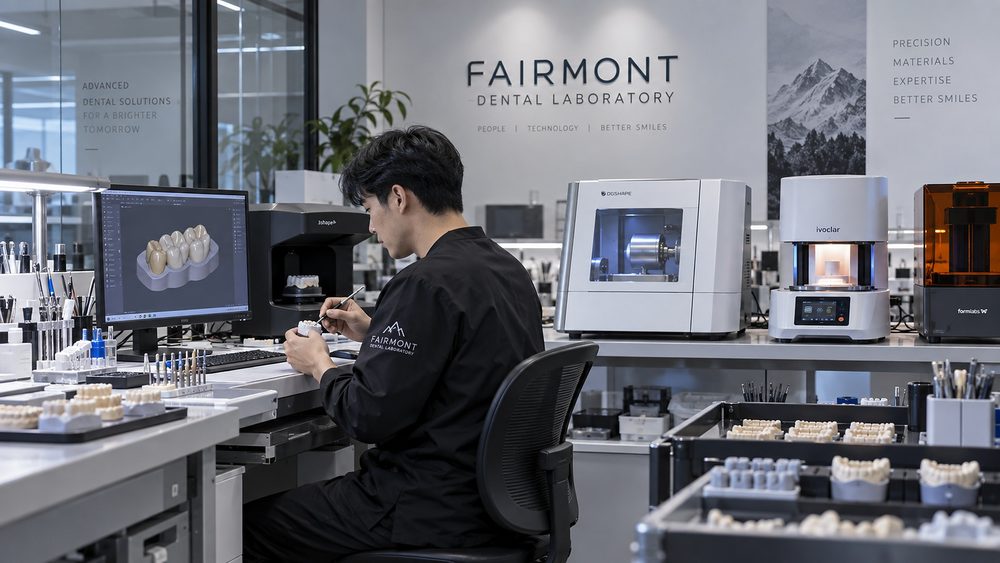
Settled, maturing and emerging
CAD design and subtractive milling of ceramics and metals are entirely settled — a laboratory using them is not doing anything remarkable, and one not using them would be unusual.
Additive manufacturing is thoroughly established for models, custom trays, surgical guides, splints, provisionals and castable patterns, and is still developing for definitive restorations where the materials evidence continues to accumulate.
Algorithmic design assistance is genuinely capable and genuinely limited: it produces a plausible answer from the data it is given. Where a margin was ambiguous in a scan, the software proposes one anyway, confidently and smoothly.
What actually changes for a practice
Some technologies change outcomes. Milling produces more consistent internal fit than casting for certain applications. Digital design allows verification before production — minimum material thickness, connector cross-section, insertion axis — so a clearance problem is identified while it can still come back to you as a decision.
Digital archiving means a fractured restoration can often be reproduced from the original record without re-appointing the patient.
Other technologies change laboratory economics without changing your experience at all. That is legitimate, and it should not be presented as a clinical benefit.
Questions worth asking any laboratory
What is made in-house and what is outsourced, and where. Whether a technician reviews automated design proposals or accepts them. What is retained digitally and for how long. Which restorations are produced by which method, and why that choice is made per case.
Those answers tell you something. A list of machine names does not.
A laboratory comfortable answering them plainly is generally the more reassuring signal, regardless of what the answers turn out to be.
The constraints technology has not removed
No process recovers information that was never captured. A margin obscured at the moment of recording is not retrievable, and an occlusal relationship recorded with the patient not in maximum intercuspation produces a wrong result however it is manufactured.
Nor does technology substitute for judgement. Material selection, occlusal design and the decision to query a marginal case are decisions, and they are made by people.
This is why the fundamentals in the Knowledge Centre have not been superseded by any of it.
Equipment inventory
A detailed description of the laboratory's production systems and materials is being prepared and will appear in this section.
Where a practice should actually invest
The technology decision that most affects a practice is its own — whether to scan, and how consistently. That changes appointments, records and workflow in a way a laboratory's equipment does not.
The honest framing is that scanning removes a category of error, adds a genuine learning period, and does not reduce the need for clinical control of the field. Practices that commit to a defined case type and do all of them digitally get past the curve; those that scan occasionally do not.
Fairmont is a preferred iTero laboratory and accepts every mainstream platform, so the choice of system is yours to make on other grounds. See supported scanners.
What we will tell you plainly
What is made in-house. How a given restoration was produced and why that method was chosen. What is retained digitally and for how long. Whether a case can be remade from an archived record.
None of those are difficult questions and none should require chasing. A laboratory that is vague about them is telling you something.
Ask directly — ask a technician covers how.
Connecting your scanner to us
The practical technology question for most practices is not what a laboratory owns but whether their own scanner can send to it directly. Fairmont is a preferred iTero laboratory and accepts every mainstream platform, and most systems allow the laboratory to be added once by an identifier — a lab ID, a connection email, or a directory search.
Once connected, sending a case is a selection at the end of the scan rather than an export, an attachment and a hope.
Call for the identifier that applies to your platform, or see connecting your scanner.
Related
About Fairmont covers the laboratory and its history. Our team covers how the work is organized and why specialization makes results repeatable.
Quality assurance covers the checks a case passes through, and digital dentistry covers submission from every scanner platform.